


Mobile App Development in Namibia: Building for a Weak Signal
Namibia had roughly 2.80 million active cellular mobile connections in late 2025 — about 90.2% of the population — against 2.00 million internet users and only around 2.46 fixed-broadband subscriptions per 100 inhabitants.
That last figure deserves attention. Fixed broadband is rare. Mobile is near universal. For most Namibians the phone is not a secondary device. It is the only computer.
The consequence for anyone building software here is direct: the app runs on a mobile connection, on a mid-range Android device, often at the edge of coverage, used by someone watching their data bundle. Tech49Originals IT Solutions builds for that reality.
Two kinds of app, two different projects
Confusing these is the most expensive mistake in mobile development.
Customer-facing apps are downloaded by the public. Success depends on onboarding, booking flows, payment integration, notifications and behaviour on a poor connection. The competition is not another app — it is the customer giving up and phoning, or not bothering.
Internal apps for field teams are used by staff who must complete work regardless of signal. Success depends on offline capability, sync reliability, battery consumption and whether a technician can finish a job with no coverage and have it upload later.
An internal app built like a consumer app fails in the field. A consumer app built like an internal tool never gets downloaded.
Building for Namibian conditions
Nationwide 4G population coverage sits at 88.4%, but that average hides enormous variation — Khomas near 98%, Kunene closer to 49%. An app assuming stable connectivity fails wherever coverage is thin. Tech49Originals caches aggressively, queues actions for later sync, never loses user input to a dropped request and shows honest connection state rather than an infinite spinner.
Prepaid data is a visible cost to most Namibian users. An app quietly consuming a bundle in background sync gets uninstalled. Payloads are compressed, unnecessary polling avoided and heavy operations left under user control.
The device a customer holds is usually not the flagship in the design studio. Tech49Originals tests on realistic mid-range hardware and keeps app size down, because download size affects install rates when data costs money.
A real example: TowME Namibia
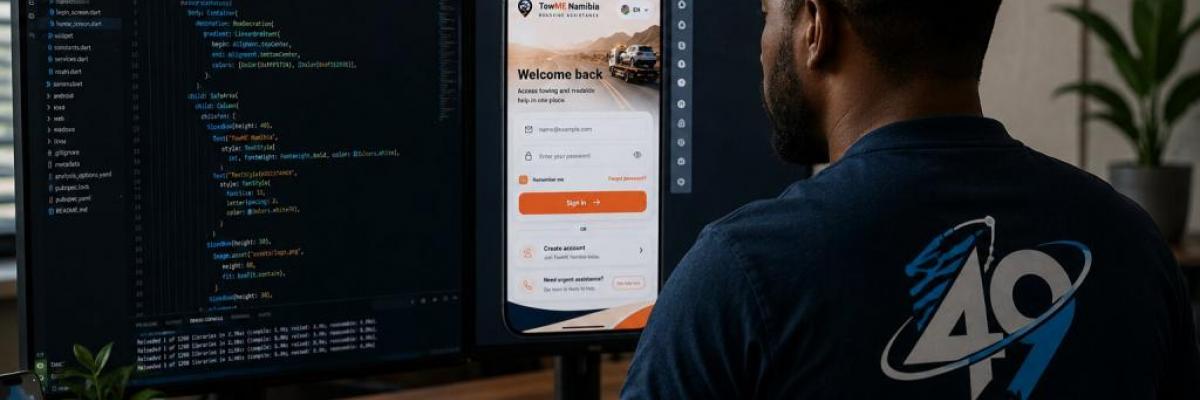
Tech49Originals developed the web and mobile platform for TowME Namibia, an on-demand vehicle towing and roadside assistance service.
Consider who opens that app: someone broken down, possibly at night, outside town, stressed, on a weak signal, with a phone that may be low on charge. Every design decision followed from that — minimum taps to request help, accurate location capture that works when the connection is marginal, clear status feedback, and tolerance for the connection dropping mid-request. A roadside assistance app that requires a strong signal fails exactly where it is needed.
Native, cross-platform, or no app at all
Cross-platform frameworks suit most business apps: one codebase for iOS and Android, faster delivery, cheaper maintenance, performance more than adequate for the majority of use cases. Native is worth the extra cost for deep hardware integration, heavy background processing or demanding graphics.
Sometimes no app is needed. A well-built mobile web application avoids app store friction, requires no download and updates instantly. When users need occasional rather than daily access, it often serves them better and costs less. Tech49Originals will say so.
The part everyone forgets
An app is the visible tenth of the project. Underneath sits a server, database, API, authentication, push notification infrastructure and admin tooling. Tech49Originals builds the whole stack with scoped APIs, proper authentication and role-based access. Mobile apps are a common breach route precisely because teams secure the website and assume the API behind the app is invisible. It is not — anyone can inspect the traffic.
What it costs
Scope drives cost: platforms, number of user roles and admin interfaces, payment integration, offline capability as a substantial engineering requirement rather than a checkbox, backend complexity, app store submission and renewal, and maintenance. That last point is the one most budgets omit — Apple and Google change requirements regularly, and an app with no maintenance arrangement will eventually break or be removed.
Tech49Originals develops iOS and Android applications from Windhoek for organisations across Namibia.
Website: www.tech49originals.com
Email: [email protected]
Phone / WhatsApp: +264 81 806 8136