

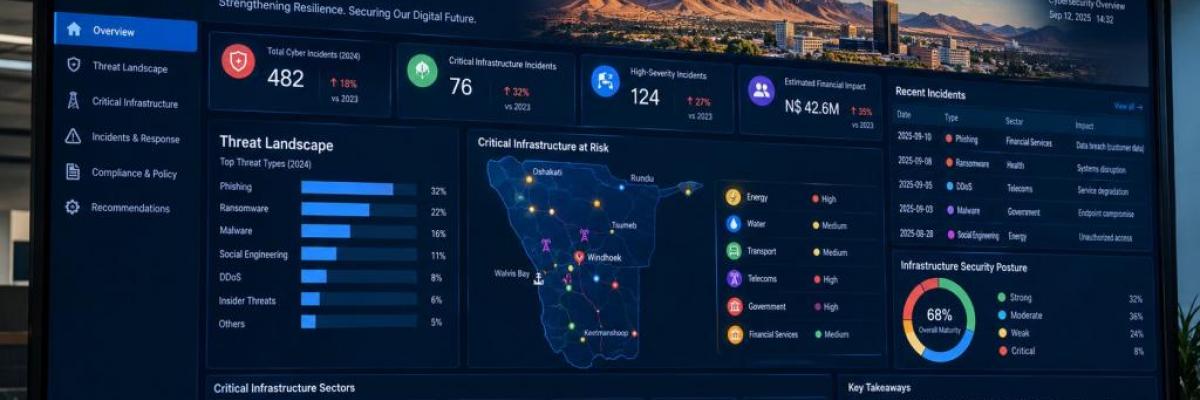
Telecoms, aviation and defence have all been breached. Tech49Originals assesses the state of critical infrastructure cybersecurity in Namibia.
The State of Cybersecurity and Critical Infrastructure in Namibia
Critical infrastructure security in Namibia has been tested repeatedly since December 2024, and the results have been public each time. Telecommunications, aviation and defence have all featured in breach reporting. That sequence is not random, and understanding why matters more than any individual incident.
What has actually happened
Telecom Namibia, December 2024. The ransomware group Hunters International exfiltrated more than 626 gigabytes of data, roughly 492,633 files. Telecom Namibia declined to pay, and the attackers published. Exposed records reportedly included data associated with eight government ministries, five regional councils, ten municipal governments and senior officials. It remains the largest known data security incident in Namibian history.
Paratus Namibia, 2025. A second major network operator compromised.
Namibia Airports Company, March 2026. NAC detected unauthorised access to parts of its network infrastructure and administrative accounts on 6 March, flagged after unusual system behaviour and intermittent network disruptions. NAM-CSIRT issued a public advisory on 16 March confirming the breach. INC Ransom subsequently published data that NAC described as including airport permit system files, parking management databases, engineering and project documentation, financial records and internal reports.
Namibian Defence Force, September 2026. Listed by the RansomHouse extortion group.
Why critical infrastructure is targeted
Critical infrastructure operators share three characteristics that attract extortion groups.
They hold data with strategic rather than merely commercial value. Personnel records, engineering documentation, procurement files and operational intelligence stay useful to a hostile party for years, unlike a stolen card number that is cancelled within a day.
They face intense pressure to restore service, which extortion operations understand and price accordingly.
And they frequently run legacy operational technology that was never designed to sit on a network reachable from the internet. Much of Namibia's infrastructure estate falls into this category.
The structural gap
NAM-CSIRT recorded 513,921 vulnerabilities and 161,547 cyber events across Namibia in Q2 2026, with increases of 39.8% and 56.7% respectively on the previous quarter. Among them, 42,941 exposed Telnet services and 10,327 DDoS participant events involving already-compromised Namibian machines.
Namibia carries a Tier 4 rating on the ITU Global Cybersecurity Index 2024, at 36.93 out of 100, classified as evolving. The National Cybersecurity Incident Management Guidelines 2026 were launched on 29 April 2026, giving the country a coordination framework for the first time. The Cybercrime Bill and Data Protection Bill remain pending.
The framework is arriving. The operational capacity to act on it is the harder part.
The sovereignty question
When Namibian infrastructure operators run security monitoring entirely on foreign platforms, processed on foreign infrastructure and supported from foreign time zones, the country's most sensitive operational telemetry leaves the country. Every authentication, every internal hostname, every network path.
For a ministry, a regulator, a utility or a defence organisation, that is a strategic exposure rather than a procurement footnote. It is also why Tech49Originals built Vanguard, a Namibian-developed security operations platform combining SIEM, XDR and network intrusion analysis, designed around Namibian bandwidth and budgets with local data residency in mind and support based in Windhoek.
What operators should prioritise
Segment operational technology from corporate networks. Establish whether you could detect data exfiltration rather than only encryption. Retain logs off the systems that produce them. Rehearse the first hour of an incident before you need it, including who notifies NAM-CSIRT. And test whether your recovery plan is a procedure or an assumption.
Namibia's critical infrastructure will continue to be targeted. The variable that remains within our control is how quickly we notice.
Tech49Originals IT Solutions provides security assessments, monitoring and incident response for Namibian infrastructure operators. Learn more at tech49originals.com or contact [email protected] | +264 81 806 8136.